In 2024, demands for democracy and human rights characterised elections worldwide, but many voters within the Commonwealth faced more dangerous political environments where peaceful resistance was met with brute force. Of the two billion people who set out to vote across 60 countries last year, 33 percent were from the Commonwealth, a 56-member union of independent countries with 2.7 billion citizens.
The “Final Call”
During the marathon election year, a dangerous precedent of state-sanctioned violence was set under a so-called ‘hybrid regime’ in Pakistan, a Commonwealth country, when on 26 November, armed snipers opened fire with live ammunition on unarmed protesters who assembled peacefully in Pakistan’s capital, Islamabad, to call for the release of jailed ex-Prime Minister, Imran Khan.
The spectacle of Khan’s sensational abduction by no less than 100 paramilitary Rangers instigating mass protests the year prior, already signalled the erosion of democratic norms in the country.
Talking to ABC in December, his sister, Aleema Khan, likened the military-style operation to historical massacres, after the deployment of 30,000 troops before the pro-democracy protests. Pakistan’s Interior Minister had issued “shoot on sight” orders, prior to Imran Khan’s protest call.
The most chilling detail Aleema described to me in the wake of the massacre, was the change in atmosphere she recalled, when security forces switched off the lights before snipers fired rounds of live ammunition into the crowd of innocent civilians in total darkness.
“It was literally a massacre—a massacre against people who did nothing but sit on the roads peacefully,” she said.
Imran Khan made a ‘Final Call’ for people to come out and protest on 26 November for three points precisely: “Human rights, democracy and rule of law, which are also reflected in the Commonwealth Charter.
“Commonwealth nations must respond to the violence by a member state against its own citizens who were protesting peacefully for democracy,” Aleema said. “Shared values like human rights, democracy, and the rule of law are enshrined in the Commonwealth charter, the organisation must stand up for the citizens of a member state.”
While the exact death toll remains disputed, Pakistanis grapple with collective trauma and question the state’s justification for such violence against its own citizens.

Imran Khan’s abduction outside Islamabad High Court on 9 May 2023 (Photo: X/@PTIofficial)
“Commonwealth nations must respond to the violence by a member state against its own citizens who were protesting peacefully for democracy. Shared values like human rights, democracy, and the rule of law are enshrined in the Commonwealth charter, the organisation must stand up for the citizens of a member state” – Aleema Khan.
A Stolen Mandate
The February 8 elections deepened the political crisis, where the colonial legacy inherited from British rule remains a defining force. The 26th Amendment, perceived as weakening the judiciary, sparked nationwide protests, leading to the unlawful arrest of Aleema Khan and her sister, Dr. Usma Khanum.
Aleema has since emerged as a symbol of resistance, and many would argue, a stabilising force at this dangerous tipping point of Pakistan’s crisis.
One particularly brutal incident that underscores the regime’s cruelty, was when a peaceful protester (“the falling man”) was thrown off a two-story shipping container by paramilitary Rangers while praying during the 26 November protests. “Tyranny is unsustainable,” Aleema says.
In January PTI (Pakistan Tehreek-e-Insaf) workers faced severe sentences, including Imran Khan’s nephew, Barrister Hassan Khan Niazi, who was convicted for his alleged involvement in the 9 May riots absent any credible evidence in the Military trials—Concerns about military overreach and state-sanctioned repression have been raised by the US, UK, EU and Australia, citing violations of international law.
The PTI considers the military trials part of a broader, two-year crackdown against the party after Khan was ousted via a parliamentary no-confidence vote in April 2022. The cases against him are now widely believed to be politically motivated.
In March 2024, a UN Working Group determined Imran Khan’s detention had no legal basis and appears to have been intended to disqualify him from running for political office.
The Working Group on Arbitrary Detention concluded in June 2024 that: “the appropriate remedy would be to release Mr. Khan immediately and accord him an enforceable right to compensation and other reparations, in accordance with international law.”
In recent weeks, Aleema Khan and overseas Pakistanis testified before UK Parliamentarians and US Congress members. These unprecedented hearings emphasised the crime of torture, transnational repression, media control, and revealed the pre-meditated nature of the midnight operation on 26 November under the command of Pakistan’s Army Chief.
Aleema Khan called for international accountability, urging countries like the UK and Australia to implement Magnitsky-style sanctions against state actors implicated in human rights abuses.
The 14-year sentence in the Al-Qadir Case handed down to Khan in January and the cessation of talks last week, has galvanised the PTI’s civil disobedience movement, urging overseas Pakistanis to suspend foreign currency remittances into Pakistan until key demands are met.
Khan’s demands are clear:
● Release of all illegally detained political prisoners
● Restoring the mandate from the February 8 elections
● Upholding rule of law and empowering the Supreme Court
The November 26 protests symbolise a broader fight for democratic integrity.
“This is much bigger than politics—This is about bringing a change in the thinking of a people. He [Imran Khan] has trained the younger generation, and a change has already come about in Pakistan where he believes you have to stand up for your own rights—you have to fight for your own rights.
“Pakistanis deserve a chance,” Aleema says.
Despite optimism in an expedient diplomatic reset with the incoming Trump administration held by many Pakistanis, Imran Khan remains resolute in his commitment to restore the rule of law, rejecting any backdoor deals and vowing to fight his cases from prison—his raison d’être for entering politics in the first place.
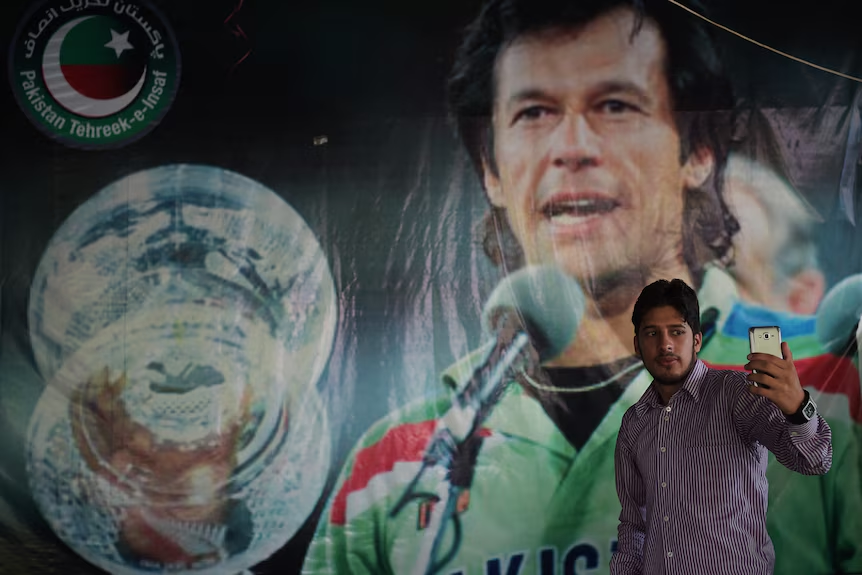
The iconic photo depicting Imran Khan leading the Pakistan National Cricket team to the Cricket World Cup in Australia in 1992, confiscated from a Pakistani Australian at Sydney Cricket Ground in November 2024.
“For the sake of justice, fairness, peace and national unity in Pakistan, Imran Khan must be set free, an all-inclusive dialogue must take place, bringing together all leaders, civilian and military,” – His Excellency Jose Ramos-Horta, president of Timor-Leste
For those in Western countries who may not be aware, the international cricketing legend, after leading his country to the Cricket World Cup in Australia in 1992 and prior to entering politics in 1996, built Pakistan’s—and the world’s first—free cancer treatment hospital and research institute in his late Mother’s name for Pakistan’s most underprivileged.
With free treatment facilities now institutionalised across major cities in Pakistan, this month the Shaukat Khanum Cancer Hospital and Research Centre commemorates 30 years of service to the people of Pakistan.
The prolonged and illegal incarceration of such a significant individual has failed to receive the international indignation it truly warrants.
Resilience For All
The Commonwealth has historically championed human rights, notably in its stand against Apartheid.
During the October 2024 Commonwealth Heads of Government Meeting (CHOGM2024) in Samoa, the outgoing Secretary General emphasised that human rights must remain central to achieving resilience for the union’s 2.7 billion citizens.
The Samoa Communiqué, one of the key documents reflecting the commitments agreed upon during CHOGM2024 is timely, having recommitted 52 leaders to the Commonwealth Charter, the Universal Declaration of Human Rights, and related international instruments.
The incoming Secretary General can be expected to use the Commonwealth’s Good Offices and diplomatic tools such as the Marlborough House Dialogues to help mediate crises like Pakistan’s, drawing on successes like Zambia’s democratic restoration in 2017.
Before a re-election is even conceivable in the future. Pakistan’s democratic crisis demands unified action to ensure conditions conducive to genuine democracy.
International leaders have echoed this sentiment.
Reflecting the values of Nelson Mandela in his appeal (prior to Imran Khan’s protest call), His Excellency, José Ramos-Horta, President of Timor-Leste and a Nobel Peace Laureate, called for Imran Khan’s release and an inclusive dialogue between Pakistan’s civilian and military leadership.
“For the sake of justice, fairness, peace and national unity in Pakistan, Imran Khan must be set free, an all-inclusive dialogue must take place, bringing together all leaders, civilian and military,” said His Excellency Ramos-Horta.
If he were alive today, Nelson Mandela, who led his country to freedom and who spent time with Imran Khan in South Africa in 1997, would have insisted on it.

“The falling man,” Pro-democracy protests D-Chowk, Islamabad on 26 November, 2024 (Photo: X/@PTIofficial).
True Freedom
Pakistan’s political turmoil highlights a global struggle for democracy, human rights and justice, with the Commonwealth positioned to play a vital role.
On the grounds of basic civil liberties and principles under various charters, the Pakistani government, a founding member of the Commonwealth, must end its crackdown on the PTI-led opposition, immediately release all illegally detained political prisoners, in line with the opinion of the UN Working Group Against Arbitrary Detention in March 2024.
Reflecting on the apparent trends of crackdown on the rights to freedom of peaceful assembly and association, UN Special Rapporteur Ms. Gina Romero will examine the global impact and emerging challenges on the exercise and protection of these rights in the context of the ‘super election’ year and present a Report on her findings to the Human Rights Council-59th session in June.
Her report will highlight emblematic case studies from different contexts, while examining the contextual environment and the role of different actors contributing to these threats.
Imran Khan’s unwavering stance and the public courage of figures like Aleema Khan exemplify resilience in the face of oppression. As Madiba once said, “It is so easy to break down and destroy. The heroes are those who make peace and build.”
Pakistan’s future hinges on whether its leaders and the international community can rise to this challenge.
First published in Pearls and Irritations
Header photo: Aleema Khan at the time of her arrest, 4 October 2024. Photo: X/@PTIofficial
Discover more from
Subscribe to get the latest posts sent to your email.
 bravemediaaus.com